Signs your business has outgrown its software
Seven warning signs your business systems can't keep up — and what to do before replacing anything.
There's a stage that almost every growing business hits, and almost nobody talks about. The systems that got you here aren't going to get you any further.
It rarely shows up as a single dramatic failure. It shows up as friction. The team spends an extra hour a day copying numbers from one place to another. The booking system keeps double-booking on Tuesdays for a reason nobody can explain. Reports that used to take ten minutes now take an afternoon. New starters need three weeks of training to do something that should take three days.
If any of that sounds familiar, your business hasn't broken. It's grown. Your software just hasn't grown with it.
I work with business owners across various industries who are right in the middle of this — and the first thing I do is help them see what's actually happening. Here are the signs I look for.
1. The team has invented workarounds
Every business has a story about a spreadsheet that started as a quick fix and is now load-bearing. Or a shared inbox that holds the only complete record of what customers have asked for. Or a printed sheet that gets passed between three people because the system doesn't quite let one of them see what the other has done.
Workarounds aren't a sign of a clever team. They're a sign that the software isn't doing what the team needs, so the team has filled in the gap. That's expensive — both in time and in the risk that the workaround will fail at the worst possible moment, like when the person who maintains the spreadsheet is on holiday.
If you can list more than two or three workarounds your team relies on, you've outgrown your software.
2. The same number lives in three different places
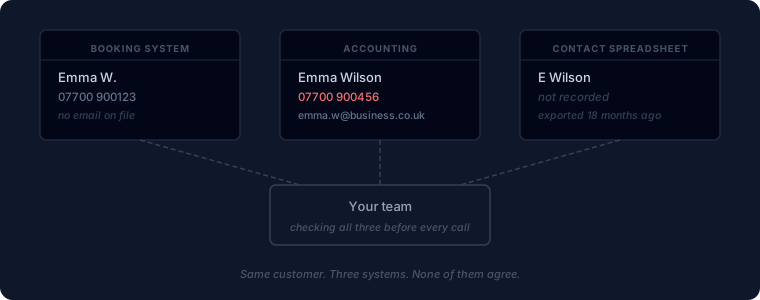
You've got customer details in your booking system, in your accounting software, and on a contact list someone exported to a spreadsheet eighteen months ago. They don't match. Nobody's quite sure which one is right. When a customer rings, the person who picks up the phone has to check all three.
This is one of the clearest signs that your systems and tools have stopped working as a system. Each one was bought to solve a specific problem, but nothing connects them. So your team becomes the connection — typing the same details into different screens, hoping nothing falls through the cracks.
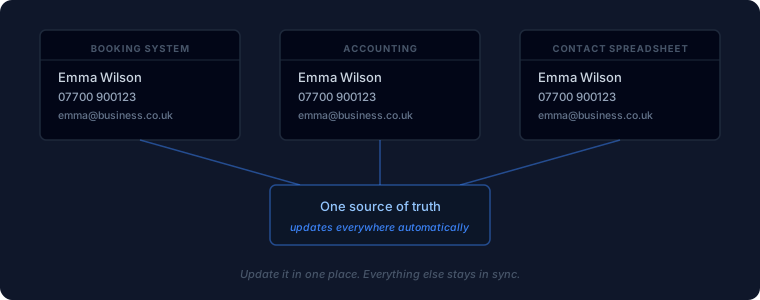
A grown-up technology setup means information lives in one place and shows up everywhere else automatically. If yours doesn't, that's not a small thing. It's the single biggest source of wasted time in most established businesses I see.
3. You can't get a straight answer to a simple question
"How many of our customers came back last quarter?" "Which of our services made us the most money in March?" "How many open jobs are over thirty days late?"
These are the questions a business owner should be able to answer in under a minute. If yours takes three days, four people, and a borrowed laptop to answer — your software has outgrown its useful life, or you've outgrown its capabilities.
Reporting is usually the canary. When the data is clean and the systems talk to each other, reports are quick. When they're not, reports become a project. And the bigger the business gets, the more often you need answers, so the more painful this gets.
4. Every new starter needs a long handover
When the only way for a new person to learn your systems is to sit next to someone for a fortnight and absorb the tribal knowledge, that's a tell. The software isn't doing the explaining. The team is. And the team has better things to do.
Good business software is largely self-explanatory. If yours isn't — if there's a list of "the way we actually do it" rules that don't match what the screens tell you — you're carrying training cost every time someone joins or leaves. That cost only grows.
5. You've stopped trying to fix it
This one is quieter, but it's often the most telling. You used to log a request when something didn't work. Now you don't bother. The team knows the booking page is slow on Mondays. They know the report doesn't add up if you run it before lunch. They've stopped flagging it because nothing happens when they do.
When a business stops trying to fix its own systems, it's because the people using them have decided the systems can't be fixed. Sometimes they're right and the software genuinely can't do what's needed. Sometimes they're wrong and the supplier just hasn't been pushed. Either way, you need someone independent to look at it, because you've already given up.
6. Your software costs are creeping and nobody's sure why
Per-seat fees that have crept from £8 to £22 over four years. Add-on modules that got switched on for one project and never switched off. Three different licences for tools that overlap. The annual renewal arrives, you sigh, and you pay it, because the alternative is a project nobody has time for.
If you can't put a single page in front of yourself that says "this is what we pay for software, and this is what each thing is for" — you've outgrown the way you bought it. There's almost always money to be saved here, often a meaningful amount, even before you fix anything else.
7. You're afraid to change anything
The system works (mostly). You don't really understand how. You know that the last time someone tried to update it, three other things broke. So you leave it alone. New ideas — a customer portal, a better way to handle bookings, a useful integration with the accounting software, or whether AI could help close some of those gaps — get deferred indefinitely, because the risk of breaking what works feels worse than the cost of staying still.
This is what it looks like when your systems have outgrown the way they were originally built. The software did what you needed five years ago, but it was never set up to grow. So now growth has stopped. That's not a software problem any more — it's a business problem.
What to do about it
If you've nodded at three or more of these, the right next move is not to phone your supplier and ask them to fix it. They're often part of why you're here.
The right move is to take stock — calmly, without buying anything yet. That usually looks like this:
- Make a list of every piece of software the business pays for. What it does, who uses it, what it costs.
- Make a list of the ten things your team does most often. Then, for each one, write down which systems are involved and where the friction is.
- Talk to two or three of the people who actually use the systems. Not the leaders — the people doing the work. Ask what they wish was different.
That's the start of a technology plan. With those three lists, you can usually see — or someone like me can usually show you — whether you need to fix the systems you have, replace them, or rebuild around the way the business actually works now. If you're not sure which kind of help you need — whether you're looking at a technology consultant or IT support — it's worth understanding the difference before picking up the phone.
It's almost never a wholesale tear-it-all-out exercise. Most established businesses I work with end up keeping more than half of what they already have, replacing one or two things that have genuinely outgrown their use, and joining things up so the team isn't doing the joining-up by hand any more.
The goal isn't shinier software. The goal is that the business stops working around its tools and the tools start working for the business.
A practical next step
If three or more of the seven signs above sound like your business, that's usually enough to know something needs to happen. A two-week assessment to understand your situation is the cleanest first move — I look at your systems, talk to your team, and come back with a plain-English plan of what's worth doing, in what order, and roughly what it costs. No jargon. No pressure to commit to a big rebuild. Just an honest read on where your technology is and what would help it keep up with the rest of the business.
If you'd like more on what working with a technology partner looks like, here's a good place to start.
And if you found any of the above useful, get in touch. Whether it's worth the investment is a question I'd rather answer for you than ask you to take on faith.
Need help with this?
If this article raised questions about your own situation, I'm happy to talk it through. A 30-minute call is usually enough to work out whether I can help.