Technology Consultant or IT Support: How to Tell
Not sure whether you need IT support or a technology consultant? A plain-English guide to telling them apart — and when you actually need both.
Most business owners I speak to aren't sure what kind of help they need. They just know something isn't right. The booking system keeps going down. The office software doesn't talk to the accounting software. Someone on the team has been saying "we need to sort our tech out" for eighteen months, and nobody has.
So they do what most people do: they call IT support.
Sometimes that's the right call. Often, it isn't. And if you get the wrong kind of help for the wrong problem, you'll spend money without fixing anything — and then you'll be back here in six months, frustrated, wondering why nothing has changed.
This guide is here to help you tell the difference.
What IT support actually does
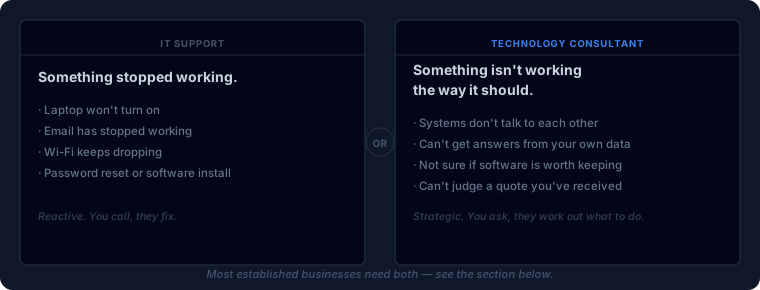
IT support — whether that's a one-person local firm, an outsourced provider, or someone on your payroll — is there to keep what you already have running.
That means things like:
- Fixing a laptop that won't turn on
- Sorting out email when it stops working
- Making sure your antivirus and backups are in place
- Setting up new starters with the software they need
- Handling password resets, broken printers, Wi-Fi dropouts
- Responding when something breaks
IT support is reactive by design. You call, they fix. They're good at it, and a decent IT provider is worth every penny for a small business — because without them, your team can't work.
But here's what IT support usually doesn't do:
- Decide whether you should be using a particular piece of software in the first place
- Build something new that doesn't exist yet
- Tell you whether an existing system is worth keeping or should be replaced
- Connect two pieces of software that don't currently speak to each other
- Assess whether the quote you got from a software company is reasonable
- Design a process that cuts a two-hour job down to ten minutes
That's not a criticism of IT support. It's just a different job.
What a technology consultant does
A technology consultant (or technology adviser, or technology partner — the name varies) works at a level above. Their job isn't to fix what's broken today; it's to figure out what you should have in the first place, and whether what you've got is serving you.
A consultant will typically help with things like:
- Working out why your systems don't talk to each other, and what to do about it
- Assessing software someone else built for you — is it any good, is it worth keeping, or is it costing you more than it's saving?
- Scoping a new piece of software before you commission anyone to build it, so you don't end up with something that doesn't do what you needed
- Looking at where your team is wasting time on manual work that a computer could do faster and more reliably
- Evaluating quotes from agencies and freelancers so you know whether the price is fair
- Helping you decide whether AI and automation tools are actually useful for your business, or just noise
- Putting together a plan for what to fix first, what to leave alone, and what to replace
A consultant is there when the question is "what should we do?" or "can tech make this better" — not "what's broken?".
Understanding what that looks like in practice is a good place to start.
The clearest test: what's the question you can't answer?
If you can describe the problem in terms of something that stopped working — the server's down, email is bouncing, a laptop is dead — you need IT support.
If you can't describe the problem at all, or if the problem is more like a feeling than a fault — "our software is rubbish, but I don't know if it's the software or us," "we spend too long doing admin and I don't know why," "someone quoted us £40,000 to build a portal and I have no idea if that's reasonable" — you probably need a consultant.
Here are some of the questions IT support usually can't answer for you, and a consultant can:
- Should we replace our booking system, or is there a way to fix it?
- We've got four different pieces of software and none of them talk to each other. What do we do?
- We were quoted £25,000 to build a customer portal. Is that sensible?
- Our developer built us something two years ago and then left. Is what we've got any good?
- Everyone keeps telling me we should "use AI." What does that actually mean for a business like ours?
- We're spending hours every week copying data between systems. Is there a better way?
- I think we need a CRM, but I don't know which one. How do I choose?
None of these are IT support questions. They're strategy questions — and they're usually the ones that end up costing a business the most money if they're answered badly.
Signs you've outgrown IT support alone
A few patterns I see regularly that suggest a business has hit the limits of what IT support can solve:
- Your IT provider keeps saying "that's not really our area" when you ask about something
- You've been told "we can fix that, but it'll just break again" and nobody's offering a way out of the loop
- You've had the same recurring problem for more than a year
- You're paying for software you're not sure you need, or not sure is working
- A supplier has quoted you a large sum to build something and you have no way to judge whether it's reasonable
- You have in-house developers or an IT person, but nobody senior enough to tell you whether the work is good
- You've been burned before — spent money with an agency or freelancer and ended up with something half-working — and you don't want to repeat it
If one or more of these sounds familiar — or perhaps you recognise some other signs your business has outgrown its software — , IT support isn't going to solve it. You need someone whose job is to step back and look at the whole picture.
You might need both
This is the part people miss. It isn't a choice between one or the other.
Most established businesses I work with need both: IT support keeps the lights on, and a consultant works on the bigger decisions in the background. A good consultant will work with your IT provider, not against them — because the day-to-day stuff still needs doing, and they're good at it.
What changes is who you call for what. Laptop won't boot? IT support. Thinking about replacing a system that's been a thorn in your side for three years? Consultant.
How to decide your next step
If you're reading this and still not sure, a simple way to work it out:
- Write down the three things about your technology that frustrate you most.
- For each one, ask: is this something breaking, or something not working the way it should?
- If the answer is "breaking" — that's usually IT support.
- If the answer is "not working the way it should," or "I don't even know what it should look like" — that's usually a consultant.
You don't need to commit to anything expensive to find out. A good consultant will spend an hour with you at no cost, listen to what's going on, and tell you honestly whether you've got a problem worth paying to solve — or whether a conversation with your IT provider would fix it.
That honesty matters. Because the worst outcome isn't picking the wrong option. It's spending another year watching the same problem cost you money, because nobody ever stopped to ask what kind of problem it actually was.
STAAL & Co helps established UK businesses get more from technology — whether that's fixing what's broken, replacing what's outdated, or working out where automation and AI can save time and money. If you've got a technology question you can't answer, a short conversation usually gets you further than another year of wondering. Get in touch.
Need help with this?
If this article raised questions about your own situation, I'm happy to talk it through. A 30-minute call is usually enough to work out whether I can help.